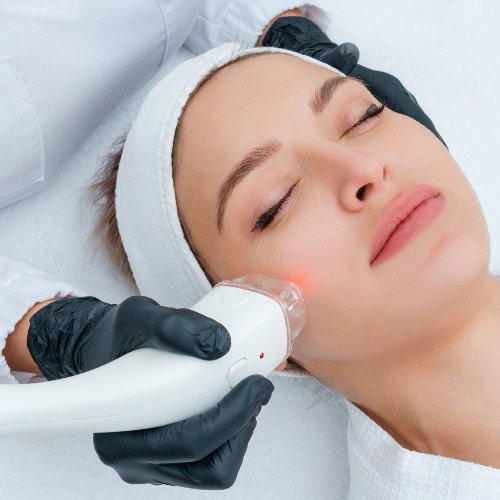
What is CO2 laser?
CO2 laser resurfacing uses carbon dioxide laser energy to remove damaged skin layers and stimulate deep collagen remodeling. There are two main approaches. Ablative CO2 removes the entire outer skin layer across the treatment area for maximum resurfacing, significant downtime of one to two weeks, and the most dramatic results. Fractional CO2 (such as Fraxel CO2 or ActiveFX) delivers the laser in a grid of microscopic columns, leaving surrounding tissue intact to accelerate healing. Fractional CO2 has become more common in Canadian clinics because it balances meaningful results with a more manageable recovery of five to ten days. Both approaches are performed by physicians or under close physician supervision given the depth and intensity of the treatment.
What CO2 laser can help with
- ✓ Significantly improving moderate to severe skin texture, including enlarged pores and rough surface irregularities
- ✓ Reducing the appearance of acne scars, surgical scars, and stretch marks
- ✓ Addressing moderate to deep wrinkles and fine lines, particularly around the eyes and mouth
- ✓ Evening out sun damage, age spots, and hyperpigmentation
- ✓ Tightening lax or crepey skin by stimulating deep collagen and elastin production
- ✓ Producing full-face rejuvenation results that more superficial treatments cannot achieve in a single session
What to expect during your CO2 laser appointment
The appointment typically runs 30 to 90 minutes depending on the area and approach. A topical numbing cream is applied well in advance, and some physicians use local anesthetic or oral sedation for more intensive ablative treatments. The laser passes across the skin in controlled pulses, producing heat and a brief burning sensation. Immediately after, the skin will be red, swollen, and raw. For fractional CO2, the first few days involve significant redness, swelling, and a bronzed or crusting appearance as the treated micro-columns shed. By day five to seven most of the peeling has resolved, though pink or red discoloration can persist for several weeks. Ablative CO2 requires a longer, more managed recovery with wound care protocols. Sun protection and a simplified, gentle skincare routine are essential throughout the healing period.
What results can you expect with CO2 laser?
Once the healing phase is complete, most people see a noticeable improvement in skin smoothness, tone, and firmness that builds further over three to six months as collagen remodeling continues. Acne scarring, deep lines, and texture irregularities show the most significant change. Results from a single ablative or fractional CO2 session are often described as equivalent to years of more gradual treatments. The degree of improvement depends on the depth of the treatment, the concern being addressed, and how well the skin heals. Patients should expect to look significantly worse before they look better during the recovery phase.
How long CO2 laser results last
CO2 laser produces some of the longest-lasting results of any non-surgical skin treatment. The collagen remodeling it triggers continues for six to twelve months after treatment, and the improvements to texture and tone are durable. With consistent sun protection and a good skincare routine, results can remain visible for three to five years or longer before a touch-up may be considered. The skin continues to age naturally, so the timeline varies by individual, lifestyle, and sun exposure habits.
Who's a good fit for CO2 laser?
CO2 laser is best suited to people with lighter skin tones (Fitzpatrick I to III) who have moderate to significant skin concerns such as deep wrinkles, acne scarring, sun damage, or significant texture irregularities, and who are prepared for meaningful downtime. It is not appropriate for darker skin tones without very careful assessment, as the heat energy carries a higher risk of post-inflammatory hyperpigmentation or permanent pigmentation changes. Fractional CO2 can be used cautiously on some medium skin tones with appropriate settings, but provider experience matters significantly. CO2 laser is not recommended during pregnancy, for people with active skin infections, those with a history of keloid scarring, or anyone who has taken isotretinoin within the past year.
Alternatives to CO2 laser?
- Fraxel (non-ablative fractional laser): less aggressive resurfacing with less downtime than CO2; better suited for mild to moderate concerns or darker skin tones
- Erbium laser: another ablative resurfacing option with slightly less downtime than CO2; less effective for deep lines and significant scarring
- RF microneedling (Morpheus8, Sylfirm): radiofrequency combined with microneedling for skin tightening and texture; safer for all skin tones, less downtime, but less dramatic results than CO2
- IPL photofacial: addresses pigmentation and redness with minimal downtime; not effective for texture, scarring, or deep lines
- Chemical peel (TCA or deep phenol): deep peels can approach CO2 results for some concerns; phenol peels in particular carry similar risks and downtime
- Surgical options (facelift, blepharoplasty): for significant skin laxity that resurfacing alone cannot adequately address
Common CO2 laser questions
How does CO2 laser work? + -
Does CO2 laser hurt? + -
How long does a CO2 laser session take? + -
How soon will I see results from CO2 laser? + -
How much downtime does CO2 laser require? + -
How many sessions does CO2 laser take? + -
Is CO2 laser suitable for all skin tones? + -
What should I avoid after CO2 laser? + -
Featured clinics
Top-rated providers offering CO2 laser.
CNTAA College
Toronto, ON
CNTAA College offers a variety of courses and programs in the medical aesthetics and beauty industry, including online courses, diploma programs, and specialized training in skin care, laser technology, and more.
Retreat Skin & Body Clinic Toronto Downtown
Toronto, ON
Discover beauty reborn at our Toronto Downtown MedSpa, where artistry meets advanced science in a serene oasis of transformation.