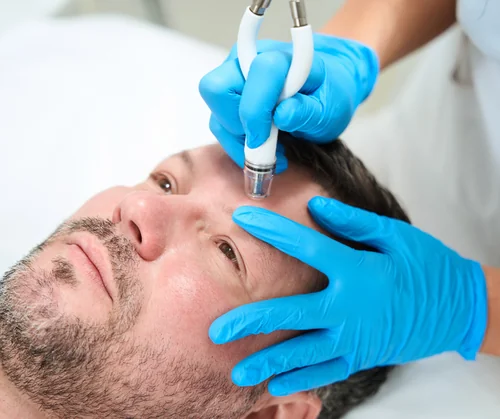
How CO2 Laser Resurfacing Works on Your Skin
CO2 laser resurfacing uses concentrated beams of carbon dioxide laser light to remove precise layers of damaged skin while triggering your body's natural healing response. The laser operates at a wavelength of 10,600 nanometers, which water in your skin cells absorbs extremely efficiently. This absorption creates controlled heat that vaporizes targeted tissue layer by layer, giving providers exceptional precision over treatment depth and intensity.
The three-phase treatment process:
- Phase one involves laser energy vaporizing the outermost skin layer (epidermis), removing damaged cells, sun spots, fine lines, and surface irregularities. The heat penetrates into the deeper dermis layer simultaneously, creating controlled injury that stimulates healing.
- Phase two activates during and immediately after treatment as heat causes existing collagen fibers to contract and tighten. This immediate tightening effect provides some instant improvement, though the most dramatic changes develop over subsequent months.
- Phase three unfolds over 3 to 6 months as your skin produces new collagen and elastin in response to the controlled injury. Fresh, healthy skin cells migrate to the surface, creating smoother texture, more even tone, and firmer appearance.
The technology comes in two main delivery methods. Traditional ablative CO2 lasers remove the entire surface layer of treated skin, providing dramatic results but requiring extensive recovery. Fractional CO2 lasers create a grid pattern of thousands of microscopic treatment columns while leaving surrounding tissue intact, significantly reducing healing time while still delivering impressive improvements.
As with any medical procedure, this information is for educational purposes and should not replace professional consultation with qualified providers.
What CO2 Laser Treatment Can Address
Aging-related skin concerns:
- Deep wrinkles and creases around the mouth, eyes, and forehead that don't respond to less aggressive treatments. CO2 lasers can dramatically soften even well-established static wrinkles by removing damaged tissue and stimulating collagen remodeling.
- Loose, crepey skin texture caused by collagen loss and sun damage over decades. The tightening effect from collagen contraction plus new collagen production firms skin considerably, though it can't replace surgical lifting for severe laxity.
- Age spots, sun spots, and uneven pigmentation that make skin look older and less vibrant. The laser vaporizes pigmented cells, revealing fresh skin with more uniform tone underneath.
- Enlarged pores that become more prominent with age and sun damage. Resurfacing stimulates skin thickening and collagen production that can make pores appear smaller and less noticeable.
Scarring and texture issues:
- Acne scars including ice pick, boxcar, and rolling scars that create uneven skin surface. CO2 lasers excel at smoothing depressed scars by removing scar tissue edges and stimulating collagen to fill depressions.
- Surgical scars or injury scars that have healed with visible texture differences or discoloration. Targeted resurfacing can blend scars more seamlessly with surrounding skin.
- Chicken pox scars and other pitted scarring from childhood illnesses or injuries. The precision of CO2 lasers allows treatment of individual scars without affecting surrounding normal skin.
- Rough, uneven skin texture from cumulative sun damage, environmental exposure, or genetics. Removing damaged surface layers reveals smoother skin while stimulating renewal processes.
Skin lesions and growths:
- Seborrheic keratoses (benign brown growths common with aging)
- Skin tags and small benign tumors
- Warts resistant to other treatments
- Certain precancerous lesions under dermatologist supervision
According to the American Society for Dermatologic Surgery, CO2 laser resurfacing remains one of the most effective treatments for moderate to severe photoaging and scarring when performed by experienced providers.
The Difference Between CO2 Laser and Other Laser Treatments
CO2 lasers are ablative, meaning they physically remove tissue by vaporizing it. This fundamental difference from non-ablative lasers explains both their superior results and their more intensive recovery requirements.
CO2 vs. non-ablative lasers:
- Non-ablative lasers (like Fraxel Dual, Clear + Brilliant) work by heating tissue without removing it, stimulating collagen production with minimal surface damage. They require virtually no downtime but produce subtler results over multiple treatments.
- CO2 lasers remove damaged tissue entirely while simultaneously heating deeper layers, providing both immediate improvement from tissue removal and progressive improvement from collagen remodeling. Single CO2 treatments often deliver more dramatic change than several non-ablative sessions combined.
- Recovery differs dramatically. Non-ablative treatments typically cause only mild redness for 1 to 3 days, while CO2 resurfacing requires 1 to 2 weeks of significant healing. The trade-off is results magnitude versus convenience.
- Cost per session is higher for CO2 treatments, but fewer sessions are needed. Many people achieve their goals with one CO2 treatment versus 3 to 5 non-ablative sessions.
CO2 vs. Erbium lasers:
- Erbium lasers (another ablative option) operate at a different wavelength that water absorbs even more efficiently. They remove tissue with less heat generation, resulting in faster healing but less skin tightening than CO2.
- CO2 lasers provide superior collagen stimulation and tightening due to the additional thermal effect. Erbium works better for superficial concerns or when minimal downtime is essential.
- Erbium carries lower risk of prolonged redness and pigmentation changes, making it often preferable for darker skin tones. CO2 delivers more dramatic results but with higher complication risk.
- Many providers combine both lasers in a single session, using CO2 for deeper resurfacing and Erbium for finishing passes to optimize results while minimizing recovery.
Fractional vs. full-field CO2:
- Fractional CO2 creates thousands of microscopic treatment columns surrounded by untreated skin that speeds healing. Recovery typically takes 5 to 7 days versus 2 to 3 weeks for full ablative treatment.
- Full-field CO2 removes the entire epidermal layer for maximum improvement of severe damage, scarring, or deep wrinkles. Results are more dramatic but recovery is more intensive.
- Fractional treatments can be repeated every few months if needed, building results progressively. Full ablative treatments are typically one-time events due to recovery intensity.
- Most modern CO2 procedures use fractional delivery unless treating extremely severe damage or preparing skin for other procedures.
Who Makes a Good Candidate for CO2 Laser Resurfacing
Ideal candidate characteristics:
- Realistic expectations about results, recovery, and the intensive aftercare commitment required. CO2 resurfacing produces dramatic improvements but demands significant healing time and sun protection.
- Moderate to severe photoaging, wrinkles, scarring, or texture issues that haven't responded adequately to less aggressive treatments. CO2 lasers are powerful tools reserved for concerns that warrant the recovery investment.
- Lighter skin tones (Fitzpatrick types I-III) face lower risk of post-inflammatory hyperpigmentation and permanent color changes. Darker skin can be treated with fractional approaches by highly experienced providers, but risks increase.
- Good overall health without conditions that impair healing like uncontrolled diabetes, active autoimmune disorders, or blood clotting problems. Your body needs robust healing capacity to recover safely.
- Non-smoker status or ability to quit completely for at least 4 weeks before and after treatment. Smoking dramatically increases complication risk and severely impairs healing.
- Ability to avoid sun exposure and commit to rigorous sun protection for several months. UV exposure during healing can cause permanent pigmentation problems.
Situations where CO2 laser may not be appropriate:
- Active acne breakouts or recent isotretinoin (Accutane) use within the past 6 to 12 months increases scarring risk significantly
- History of keloid scarring or abnormal wound healing raises concerns about excessive scarring from the controlled injury
- Very dark skin tones face higher risk of permanent hypopigmentation (lightening) or hyperpigmentation (darkening)
- Recent cosmetic procedures including fillers, Botox, or other lasers within the treatment area may need to heal first
- Pregnancy or breastfeeding requires postponing treatment until after this period ends
- Unrealistic timeline expectations for recovery or inability to take adequate time off work and social activities
Understanding CO2 laser downtime requirements helps you determine if the recovery commitment fits your life circumstances and schedule.
How Aggressive Is CO2 Laser Treatment
CO2 laser resurfacing ranks among the most aggressive non-surgical skin treatments available, which explains both its impressive results and its substantial recovery requirements. The treatment's aggressiveness varies significantly based on settings, coverage area, and whether fractional or full ablative approach is used.
Aggressiveness factors:
- Full ablative CO2 removes the entire epidermal layer plus varying amounts of dermis depending on settings. This represents maximum aggressiveness with 2 to 3 week recovery but delivers the most dramatic transformation for severe damage.
- Fractional CO2 at high density and depth settings approaches full ablative intensity in terms of results while reducing recovery to 7 to 10 days. Lower density fractional treatments offer a gentler option with 4 to 5 day healing.
- Treatment depth determines aggressiveness more than any other factor. Superficial passes target only the epidermis and upper dermis (300-500 microns), while deep resurfacing penetrates into mid-dermis (500-1000 microns or more).
- Coverage area affects overall trauma to your system. Full face resurfacing creates more extensive injury than treating isolated areas like around the eyes or mouth, impacting how your body handles recovery.
How it compares to other aggressive treatments:
- More aggressive than: Chemical peels (even deep TCA peels), microneedling, dermabrasion, all non-ablative lasers
- Similar aggressiveness to: Deep phenol peels, aggressive dermabrasion, other ablative lasers like Erbium at maximum settings
- Less aggressive than: Surgical procedures like facelifts, though CO2 often complements rather than replaces surgery
The controlled nature of laser energy delivery allows providers to customize aggressiveness to your specific needs and tolerance. Conservative fractional treatments can address mild concerns with minimal recovery, while aggressive full ablative resurfacing tackles severe damage that would otherwise require surgery.
Fractional CO2 Laser Technology Explained
Fractional CO2 represents a major advancement that made powerful laser resurfacing accessible to more people by dramatically reducing recovery time while maintaining impressive results. The technology divides laser energy into thousands of microscopic treatment zones rather than treating skin as one continuous surface.
How fractional delivery works:
- The laser beam passes through a specialized handpiece that creates a grid pattern of tiny treatment columns, each typically 0.1 to 0.4 mm in diameter. These microscopic columns penetrate to predetermined depths while leaving surrounding tissue completely untouched.
- Treatment density is adjustable, typically ranging from 5% to 70% coverage. Lower density (5-20%) provides gentler treatment with faster healing, while high density (40-70%) approaches full ablative results with moderately reduced recovery.
- Untreated skin between treatment columns serves as healing reservoirs. Healthy cells from these areas migrate into treated zones, accelerating re-epithelialization (formation of new surface skin) from 10-14 days to 5-7 days.
- The microscopic wound healing triggers intense collagen remodeling around each treatment column, creating improvement that extends beyond the directly treated areas through signaling to surrounding tissue.
Advantages of fractional approach:
- Dramatically reduced healing time compared to full ablative treatment allows people with busy lives to consider CO2 resurfacing
- Lower complication risk, particularly for infection, scarring, and pigmentation changes
- Ability to treat off-face areas like neck, chest, and hands that don't heal as reliably with full ablative approaches
- Option to build results progressively through multiple fractional sessions rather than committing to one intensive full ablative treatment
- Better safety profile for darker skin tones, though risks still exist and provider experience is critical
Common fractional CO2 systems:
- Fraxel re:pair (first fractional CO2 laser introduced)
- Lumenis UltraPulse with ActiveFX and DeepFX modes
- Sciton Halo (hybrid fractional combining two wavelengths)
- CO2RE by Candela
- SmartXide DOT by DEKA
Your provider selects the specific system and settings based on your skin concerns, tolerance for downtime, skin type, and desired results magnitude.
What to Expect During CO2 Laser Skin Resurfacing
Pre-treatment preparation:
- Most providers prescribe a pre-treatment regimen starting 2 to 4 weeks before your procedure. This typically includes retinoids to prepare skin, hydroquinone to reduce pigmentation risk, and sometimes antiviral medication if you're prone to cold sores.
- You'll need to avoid sun exposure and discontinue certain medications or supplements that increase bleeding risk like aspirin, NSAIDs, vitamin E, and fish oil for about a week beforehand.
- Arrive with completely clean skin, free of makeup, lotions, or any products. Your provider will cleanse the treatment area thoroughly before beginning.
- Photography documents your baseline appearance for comparison during follow-up visits. These clinical photos help track progress as results develop over months.
During the treatment:
- Numbing begins 45 to 60 minutes before the laser starts with topical anesthetic cream applied thickly to treatment areas and covered with plastic wrap. Some providers offer oral sedation or use nerve blocks for additional comfort.
- The actual laser treatment takes 30 minutes to 2 hours depending on treatment area size and aggressiveness level. You'll hear popping sounds and smell a burning odor as the laser vaporizes tissue. Most people find the sensation tolerable with proper numbing.
- Your provider works systematically across treatment areas, often making multiple passes at different settings to achieve optimal depth and coverage. Fractional treatments involve less continuous discomfort than full ablative approaches.
- Immediate whitening (frosting) appears as the laser works, followed by redness and swelling. Your skin will look raw and feel hot immediately after treatment ends. Cool compresses provide relief.
Immediate post-treatment:
- Your provider applies healing ointment and may cover the area with special bandages or a biological dressing that stays in place for several days. These dressings protect fragile new skin and minimize infection risk.
- You'll receive detailed aftercare instructions covering cleaning protocols, ointment application frequency, activity restrictions, and warning signs requiring immediate contact. Following these instructions precisely is critical for optimal healing.
- Pain and discomfort peak in the first 24 to 48 hours but are generally manageable with prescribed or over-the-counter pain medication. Ice packs help significantly with swelling and heat sensation.
- Plan to rest completely for at least 2 to 3 days after treatment. Your skin needs all your body's healing resources, and activity increases swelling and discomfort. Most people take 5 to 7 days off work minimum.
CO2 Laser Results Timeline and Longevity
Immediate to 2 weeks:
- Right after treatment, skin appears red, swollen, and raw. Don't judge results yet as you're in the injury and inflammation phase. The frosted appearance gives way to angry redness and significant swelling.
- Days 3-5 bring peeling and sloughing as treated tissue separates from new skin forming underneath. This phase looks alarming but signals normal healing. Resist any urge to pick or peel skin manually.
- By day 7-10 for fractional treatments (14-21 for full ablative), new pink skin emerges as old tissue completely sheds. You can typically resume normal activities with makeup covering residual pinkness.
- Some immediate tightening and smoothing is visible once swelling resolves, but this represents only a fraction of eventual results. The real transformation happens gradually over subsequent months.
Weeks 2-12:
- Pinkness gradually fades from bright pink to light pink to near-normal over 4 to 12 weeks. Fractional treatments resolve faster than full ablative. Makeup camouflages residual color for work and social activities.
- Skin texture improves noticeably as new collagen forms and surface roughness smooths out. Fine lines soften progressively, and pore size appears reduced. These changes accelerate around weeks 4-8.
- Pigmentation evens out as new skin without sun damage replaces old pigmented cells. Brown spots and melasma improve dramatically, revealing clearer, more uniform tone.
- Deeper wrinkles and scars show progressive improvement but may not reach maximum correction until 3 to 6 months post-treatment. Collagen remodeling is a slow process that continues for half a year or longer.
Months 3-6:
- Peak results typically manifest around month 4-6 as collagen production and remodeling reach their zenith. Skin looks noticeably firmer, smoother, and more youthful than before treatment.
- Some people notice continued subtle improvements even beyond 6 months as collagen continues maturing and remodeling. The skin you see at one year represents the final, stable result.
- Maintenance may involve less aggressive treatments like non-ablative lasers, chemical peels, or topical retinoids to preserve results. Some people repeat fractional CO2 every 1-2 years.
Longevity expectations:
- Results can last 5 to 10 years or longer with proper sun protection and skincare. The new collagen you've built is real, structural improvement that persists.
- Natural aging continues, so while you've turned back the clock significantly, you're not frozen at this improved state. Results gradually diminish as normal aging processes resume.
- Sun protection is absolutely critical for longevity. UV exposure undoes laser benefits by damaging newly formed skin and breaking down collagen. Religious SPF use extends results dramatically.
- Lifestyle factors like smoking, poor nutrition, inadequate hydration, and environmental pollutants accelerate aging and can shorten how long results last.
Understanding full face CO2 laser resurfacing timelines helps you plan for the extended improvement period and maintenance needs.
Is CO2 Laser Resurfacing Worth the Investment
The value equation for CO2 laser resurfacing depends entirely on how much your skin concerns bother you, whether you're a good candidate, and your tolerance for the recovery process and financial investment.
When CO2 laser makes sense:
- You have moderate to severe photoaging, wrinkles, or scarring that significantly affects your confidence or appearance. The dramatic improvement possible with CO2 resurfacing can be life-changing for people with extensive sun damage or disfiguring scars.
- Less aggressive treatments haven't delivered satisfactory results, and you're considering surgery but want to try a non-surgical option first. CO2 resurfacing can delay or even eliminate the need for surgical intervention in some cases.
- You can commit to proper recovery including time off work, strict sun avoidance, and intensive aftercare. The investment only pays off if you heal optimally, which requires dedication to the protocol.
- You're realistic about what laser treatment can and cannot achieve. It dramatically improves skin quality but doesn't replace volume loss, lift sagging tissue, or stop aging permanently. CO2 laser costs reflect the treatment's powerful capabilities.
Situations where alternatives might be better:
- Your concerns are mild and could be addressed with gentler treatments. Don't subject yourself to intensive recovery for problems that don't warrant it. Save CO2 resurfacing for when you really need it.
- You can't take adequate time off for recovery or can't avoid sun exposure due to work or lifestyle. Poor healing conditions compromise results and increase complication risk, wasting your money.
- You're hoping laser will fix concerns better addressed surgically, like significant jowling, neck laxity, or under-eye bags. Lasers have limitations, and using them for the wrong indications leads to disappointment.
- You have skin type or health conditions that increase risks substantially. The potential for complications may outweigh benefits, making safer alternatives more appropriate.
Most people who are appropriate candidates and have realistic expectations find CO2 resurfacing well worth the investment and recovery. The dramatic improvement in skin quality, texture, and appearance can take years off your face and significantly boost confidence.