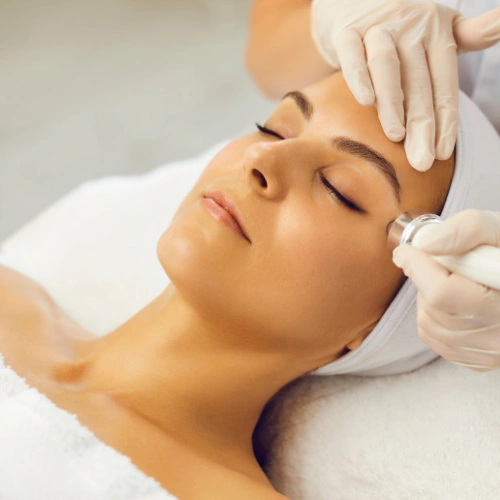
What is Fraxel?
Fraxel is a brand name for a family of fractional lasers made by Solta Medical. The most widely used version in Canadian clinics is the Fraxel Dual, which offers two wavelengths in one device: the 1550nm erbium fiber laser, which penetrates deeper into the skin to address texture, scarring, and fine lines, and the 1927nm thulium laser, which works more superficially to target pigmentation and sun damage. Providers often use one or both wavelengths in a single session depending on the concern being treated. Because Fraxel treats only a fraction of the skin in a grid of microscopic columns while leaving surrounding tissue intact, the body heals faster than with fully ablative resurfacing, and the risk profile is more moderate.
What Fraxel can help with
- ✓ Reducing the appearance of acne scars, surgical scars, and stretch marks
- ✓ Smoothing uneven skin texture and enlarged pores
- ✓ Fading sun damage, age spots, melasma, and other forms of hyperpigmentation
- ✓ Softening fine lines and early to moderate signs of skin aging
- ✓ Improving overall skin tone, clarity, and radiance
- ✓ Treating the face, neck, chest, and hands for a more consistent, rejuvenated appearance
What to expect during your Fraxel appointment
A topical numbing cream is applied 60 to 90 minutes before the session. The treatment itself takes 20 to 45 minutes. The laser handpiece is passed across the skin in overlapping passes, delivering heat in a pattern of microscopic columns. The sensation is described as intense heat with a prickling or stinging quality. A cooling device is used simultaneously to manage discomfort. Immediately after, the skin looks red and feels hot, similar to a significant sunburn. Over days two through five, the skin takes on a bronzed, rough texture as the treated columns push through the surface before shedding. This is normal and expected. By days five to seven most of the flaking has resolved, and the new skin underneath looks noticeably smoother and more even. Plan at least five to seven days away from work or social events.
What results can you expect with Fraxel?
Results develop progressively. Most people see an initial improvement in texture and glow within one to two weeks of treatment, with ongoing refinement over three to six months as collagen remodeling continues beneath the surface. A single session produces meaningful results, but a series of two to four treatments spaced four to eight weeks apart delivers the most significant change for concerns like acne scarring or deeper pigmentation. Fraxel produces more dramatic results than superficial treatments but less dramatic results than full ablative CO2, and typically requires more sessions than CO2 to achieve comparable improvement in deeper concerns.
How long Fraxel results last
The collagen remodeling stimulated by Fraxel is long-lasting, and improvements to texture and tone are durable with proper sun protection. Most people maintain results for one to two years before considering a touch-up. Sun damage and pigmentation concerns can recur more quickly without consistent daily SPF, particularly in areas prone to melasma. Many providers recommend annual maintenance sessions for people who have completed a full series and want to stay ahead of ongoing aging and sun exposure.
Who's a good fit for Fraxel?
Fraxel is well-suited to people with mild to moderate skin concerns, including acne scarring, sun damage, uneven texture, and early to moderate signs of aging, who want more meaningful improvement than peels or microneedling can provide but are not prepared for the longer downtime of CO2 laser. It is appropriate for Fitzpatrick skin types I to IV with care, and some experienced providers treat type IV and V skin using lower settings with pre-treatment conditioning. It is not recommended during pregnancy, for people who have taken isotretinoin within the past year, or for those with active skin infections or open lesions in the treatment area. Tanned skin should be avoided at the time of treatment due to increased risk of pigmentation changes.
Alternatives to Fraxel?
- CO2 laser: more aggressive ablative resurfacing for deeper wrinkles, significant scarring, and advanced sun damage; more downtime but more dramatic results per session
- RF microneedling (Morpheus8, Sylfirm): combines radiofrequency with microneedling for skin tightening and texture; safer for darker skin tones and less downtime than Fraxel
- IPL photofacial: targets pigmentation and vascular concerns with minimal downtime; less effective for texture or scarring
- Microneedling: stimulates collagen with less heat-based risk; more sessions needed than Fraxel for comparable texture improvement, safer for all skin tones
- Chemical peel (medium to deep): TCA peels can address similar concerns to Fraxel with comparable downtime; less precise than laser but more widely available
Common Fraxel questions
How does Fraxel work? + -
Does Fraxel hurt? + -
How long does a Fraxel session take? + -
How soon will I see results from Fraxel? + -
How much downtime does Fraxel require? + -
How many Fraxel sessions are needed? + -
Is Fraxel suitable for all skin tones? + -
What should I avoid after Fraxel? + -
Featured clinics
Top-rated providers offering Fraxel.
Signature Cosmetic Clinic | Ultherapy | ThermageFLX | Sofwave | PicoWay | PicoSure | RF Microneedling | EmsculptNEO | Markham
Toronto, ON
Our Treatments With over 50+ different treatments and a modern, comfortable clinic space, we’re proud to be one of the best aesthetic clinics in the GTA.
Dr. Jadranka Jambrosic - Skin Cancer Screening Specialist
Toronto, ON
Expert care means results you can trust. Your True You journey begins here.