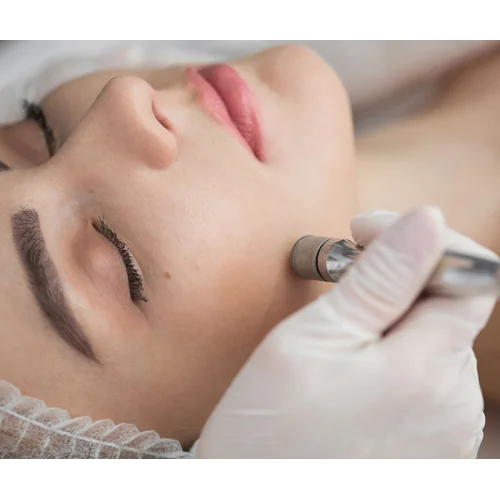
You're considering microdermabrasion, and now you're wondering what it'll actually cost you. The price tags you're seeing online probably range anywhere from $75 to $400 per session, which isn't exactly helpful when you're trying to budget. This page breaks down the real microdermabrasion cost, what affects the final number, and how to figure out your total investment based on your specific goals.
What Microdermabrasion Actually Costs
The average cost of microdermabrasion is $136 per session according to the American Society of Plastic Surgeons. However, individual sessions typically range from $100 to $250 at most providers, with some high-end medical spas charging up to $400 or more.
Here's the important part: you won't just need one session. Most people require six to twelve treatments to see their desired results, with sessions spaced two to four weeks apart. So if you're paying $150 per session and need eight treatments, you're looking at $1,200 total. After your initial series, you'll likely want maintenance treatments every month or two to keep your results, which adds ongoing costs to consider.
The price varies significantly based on several factors including your location, the type of provider you choose, whether you're getting crystal or diamond-tip microdermabrasion, and whether the treatment is combined with other services. This information is meant to help you understand the financial commitment involved, but it shouldn't replace a consultation with a qualified provider who can give you a personalized treatment plan and accurate pricing.
Breaking Down Microdermabrasion Cost Per Session
Most providers charge per session, and that single-treatment microdermabrasion price can fluctuate quite a bit. Medical spas and dermatologist offices often charge $150 to $250 per session, while standalone beauty spas might offer treatments for $75 to $150.
Diamond-tip microdermabrasion generally costs more than crystal microdermabrasion due to its precision and the equipment involved. You might pay $20 to $50 more per session for diamond-tip treatments. Some providers also charge differently based on the treatment area. A full-face treatment is typically the standard price, but if you're adding your neck, chest, or hands, expect to pay an additional $50 to $100 per area.
Sessions usually last 30 to 60 minutes, and the treatment itself is just one component of what you're paying for. Your cost also covers the provider's expertise, the equipment maintenance, disposable tips or crystals, pre-treatment cleansing products, and post-treatment serums or moisturizers.
Why Microdermabrasion Prices Vary So Much
Location plays a huge role in pricing. Treatments in major metropolitan areas like New York, Los Angeles, Toronto, or Vancouver typically cost 30% to 50% more than the same service in smaller cities or suburban areas. A session that costs $100 in a mid-sized city might run $200 in a high-cost urban center.
The type of provider you choose also impacts the microdermabrasion price significantly. Board-certified dermatologists and plastic surgeons typically charge the most, often $200 to $400 per session, because you're paying for their medical expertise and oversight. Medical spas run by licensed nurses or physician assistants usually charge $150 to $250, while licensed aestheticians at day spas might offer treatments for $100 to $175.
Your provider's experience and reputation matter too. Someone who's been performing microdermabrasion for fifteen years and has an excellent track record will likely charge more than a newly licensed aesthetician. The equipment quality also affects pricing. Newer, medical-grade machines with advanced features cost providers more, and they pass some of that cost along to you.
Package deals can significantly reduce your per-session cost. Many providers offer series pricing where you buy six to ten sessions upfront at a discount. Instead of paying $150 per session individually, you might pay $120 per session when buying a package of eight treatments, saving you $240 total.
Total Microdermabrasion Cost: Planning for Multiple Sessions
Here's where understanding the full financial picture becomes important. A single microdermabrasion session will give you some immediate glow and smoothness, but meaningful improvements to texture, fine lines, acne scars, or pigmentation require consistent treatments over time.
Most providers recommend an initial series of six to twelve sessions. If you're dealing with mild concerns like dullness or rough texture, you might only need six treatments. More stubborn issues like acne scarring, deeper pigmentation, or significant sun damage often require ten to twelve sessions to see substantial improvement.
Let's look at realistic total costs based on different scenarios. For mild skin concerns with six sessions at $125 each, you're looking at $750. For moderate concerns requiring eight sessions at $150 each, that's $1,200. For more significant issues needing twelve sessions at $175 each, the total comes to $2,100.
Don't forget about maintenance. After completing your initial series, most people schedule maintenance treatments every four to eight weeks to sustain their results. At $150 per session, that's $450 to $900 per year in ongoing costs, depending on how frequently you go.
Average Cost of Microdermabrasion by Provider Type
Understanding what different provider types charge helps you make informed decisions about where to book your treatments. Dermatologist offices typically charge the highest rates, usually $200 to $400 per session. You're paying for medical oversight and the peace of mind that comes with treatment from a physician-supervised facility.
Medical spas fall into the mid-to-high price range at $150 to $300 per session. These facilities are often run by doctors but treatments are performed by licensed aestheticians or nurses. You get medical-grade equipment and professional oversight at a slightly lower price point than a dermatologist's office.
Day spas and beauty salons offer the most affordable option, typically $75 to $175 per session. The equipment might be less advanced, and the providers are usually licensed aestheticians rather than medical professionals. This can be a good choice for maintenance treatments or if you have straightforward skin concerns.
Some providers now offer mobile microdermabrasion services where they come to your home. These typically cost $150 to $300 per session, similar to medical spa pricing, with the added convenience factor built into the cost.
Microdermabrasion Cost Near Me: Geographic Pricing Differences
Where you live significantly impacts what you'll pay. Major cities command premium prices across the board. In places like Manhattan, San Francisco, or downtown Toronto, expect to pay $200 to $400 per session even at mid-range providers.
Suburban areas surrounding major cities typically offer more moderate pricing, often $125 to $250 per session for the same quality of treatment. Rural areas and smaller cities generally have the lowest prices, with sessions ranging from $75 to $175. However, your options for highly experienced providers might be more limited in these areas.
Even within the same city, neighborhood matters. Upscale shopping districts and affluent neighborhoods usually have higher prices than providers in more modest areas. A medical spa in Beverly Hills will charge more than one in the San Fernando Valley, even if they're using identical equipment and techniques.
If you live in a high-cost area, it might be worth checking providers in nearby suburbs or less expensive neighborhoods. A 20-minute drive could save you $50 to $100 per session, which adds up significantly over a treatment series.
Is Microdermabrasion Covered by Insurance?
The short answer is almost certainly no. Microdermabrasion is usually considered an elective cosmetic procedure, so standard health insurance won't cover the cost. Insurance companies classify it alongside other appearance-focused treatments that aren't medically necessary.
There are rare exceptions where insurance might provide coverage. If microdermabrasion is being used to treat certain medical conditions like pre-cancerous skin lesions or as part of a comprehensive acne treatment plan deemed medically necessary by a dermatologist, some insurers might cover it. However, you'll need extensive documentation, pre-authorization, and a very specific medical justification.
Even in medical cases, insurance companies often prefer other treatment methods first. They typically require proof that you've tried multiple other approaches before they'll consider covering microdermabrasion. The approval process can take weeks or months, and there's no guarantee of coverage even with proper documentation.
Since insurance coverage is so unlikely, plan to pay out of pocket. Some providers accept flexible spending account (FSA) or health savings account (HSA) funds, which can help you use pre-tax dollars for your treatments.
How Many Sessions of Microdermabrasion Do You Need?
The number of treatments you need directly impacts your total cost, so understanding this helps you budget accurately. For general skin brightening and maintenance, you might only need four to six sessions to achieve a noticeable difference in your complexion's radiance and smoothness.
Moderate concerns like fine lines, mild sun damage, or uneven texture typically require six to eight sessions. You'll start seeing improvements after three or four treatments, but the full results develop over the complete series as your skin continues to regenerate and produce new collagen.
More significant issues such as acne scars, deeper pigmentation, age spots, or substantial sun damage often need ten to twelve sessions for meaningful improvement. Some people with very stubborn concerns continue treatment for sixteen sessions or more, though this is less common.
Your provider spaces these treatments two to four weeks apart to allow your skin time to heal and regenerate between sessions. Scheduling them too close together can irritate your skin without providing better results, while spacing them too far apart means you lose some of the cumulative benefits.
After your initial series, plan on maintenance treatments to keep your results. Most people schedule these every four to eight weeks, depending on their skin's response and their budget. Think of it like getting regular haircuts to maintain a good style rather than growing it out and starting over.
Comparing Microdermabrasion Cost to Similar Treatments
Wondering how microdermabrasion pricing stacks up against other exfoliating treatments? Dermaplaning typically costs $75 to $150 per session, slightly less than microdermabrasion, and it removes fine facial hair along with dead skin cells.
Chemical peels vary widely in price based on their depth and strength. Superficial peels might cost $100 to $200, similar to microdermabrasion, while medium-depth peels can run $200 to $600 per session. You can learn more about how these treatments compare in terms of benefits and results.
Traditional dermabrasion is a much more intensive procedure that costs significantly more, typically $1,500 to $4,000 for a single treatment. However, it works on deeper skin layers and you usually only need one session rather than a series. Find out more about dermabrasion versus microdermabrasion differences.
Laser resurfacing is another option that generally costs $1,000 to $3,000 per treatment. Like dermabrasion, it's more aggressive but may provide more dramatic results for certain concerns.
Ways to Save on Microdermabrasion Costs
Package deals are one of the best ways to reduce your per-session cost. Most providers offer series pricing where buying six to ten treatments upfront gives you a 15% to 25% discount. If individual sessions cost $150, a package of eight might bring the per-session price down to $120, saving you $240 total.
Many medical spas and dermatology offices run seasonal promotions, especially during slower months like January and February. Signing up for email lists or following providers on social media can alert you to these deals. You might find offers like "buy six sessions, get one free" or "$100 off a series of eight treatments."
Some providers offer first-time client discounts to encourage new patients to try their services. These promotions typically take $25 to $50 off your first session. While this doesn't dramatically reduce your total cost, it's a good way to test a provider before committing to a full series.
Combining microdermabrasion with other treatments during the same visit sometimes results in package pricing. If you're already getting a facial or another service, adding microdermabrasion might cost less than scheduling it separately.
Membership or loyalty programs at certain medical spas can provide ongoing savings. You might pay a monthly fee of $50 to $100 in exchange for discounted services and priority booking. If you're planning regular maintenance treatments, this can add up to significant savings over time.
Hidden Costs to Consider
Beyond the session price, there are additional expenses that can catch you off guard. Many providers recommend or require specific skincare products for pre and post-treatment care. You might need to purchase a gentle cleanser, specialized moisturizer, and high-SPF sunscreen, which can add $50 to $150 to your upfront costs.
If you develop any complications or have concerns between appointments, follow-up visits might incur additional charges. Most providers include a brief check-in, but if you need more extensive evaluation or treatment adjustments, expect potential extra fees.
Parking fees at urban locations can add $10 to $30 per visit if you're seeing a provider in a downtown area. Over a series of ten treatments, that's an extra $100 to $300 you might not have factored in.
Travel costs matter too if you're driving to a provider in another city or neighborhood to get better pricing. Make sure the savings actually offset your gas and time.
Is Microdermabrasion Worth the Cost?
This depends entirely on your expectations, budget, and skin concerns. For people dealing with dull skin, rough texture, or mild signs of aging who can comfortably afford $1,000 to $2,000 for an initial series plus ongoing maintenance, microdermabrasion often delivers satisfying results.
The treatment provides visible improvements with minimal downtime, making it appealing for people who want to enhance their appearance without surgery or extensive recovery periods. Most people notice their skin feels smoother and looks brighter after just one session, which can be encouraging as you continue through a series.
However, if you're expecting dramatic transformation of deep wrinkles or significant scarring, microdermabrasion probably won't meet those expectations no matter how much you spend. The treatment works on surface-level concerns, and there are limits to what it can achieve.
Budget constraints are a legitimate factor to consider. If paying for a series would create financial stress, it might not be the right time for this treatment. There's no shame in waiting until it fits more comfortably into your budget or exploring more affordable alternatives like quality at-home exfoliation.
Want to understand exactly what you're paying for? Learn more about the benefits of microdermabrasion to decide if the results justify the investment for your specific situation.
Financing Options for Microdermabrasion
Many providers offer payment plans that let you spread the cost over several months. Instead of paying $1,200 upfront for a series, you might pay $200 per month for six months. Some charge interest on these plans while others offer interest-free financing if you complete payment within a specific timeframe.
Medical credit cards like CareCredit are designed specifically for healthcare and cosmetic procedures. These cards often provide promotional financing periods where you pay no interest if you pay off the balance within six, twelve, or eighteen months. Just be aware that if you don't pay off the full balance during the promotional period, you'll typically be charged retroactive interest at a high rate.
Using a regular credit card is another option, though you'll want to consider the interest rate and how quickly you can realistically pay it off. A rewards card that gives you cash back or points might offset a small portion of the cost.
Health savings accounts (HSAs) and flexible spending accounts (FSAs) can sometimes be used for microdermabrasion, particularly if you have a letter from your dermatologist stating it's medically necessary for treating a specific condition. Even if it's purely cosmetic, some FSA administrators may approve the expense, though policies vary.
Some employers offer supplementary health benefits or wellness stipends that might apply to skincare treatments. It's worth checking your employee benefits package to see if any funds could offset your microdermabrasion costs.
Questions to Ask About Cost During Your Consultation
Before committing to treatment, get clarity on exactly what you'll pay. Ask your provider what's included in the session price. Some providers include post-treatment products, while others charge separately for everything beyond the actual procedure.
Find out if they offer package pricing and whether you're required to prepay for the entire series or can pay per session. Ask about their cancellation and refund policies too. If you prepay for ten sessions but need to stop treatment after six for any reason, what happens to your remaining balance?
Inquire about additional fees for treating multiple areas. The quoted price might only cover your face, with extra charges for your neck, chest, or hands. Get specific numbers for any areas you're interested in treating.
Ask whether there are costs for the required skincare products and whether you must purchase them from the provider or can source them elsewhere. Some practices mark up retail products significantly, while others sell them at or near retail price.
Finally, ask about maintenance costs and recommended frequency. Understanding the long-term financial commitment helps you make an informed decision about whether this treatment fits your budget beyond just the initial series.
Finding Affordable Microdermabrasion Near You
Start by researching multiple providers in your area to compare pricing. Don't just look at the per-session cost; factor in package deals, included products, and the provider's qualifications and reputation.
Beauty schools and aesthetician training programs sometimes offer discounted services performed by students under instructor supervision. You might pay $30 to $60 per session, though treatments may take longer and results can be more variable than with experienced providers.
Some dermatology offices have newer aestheticians or residents who perform treatments at reduced rates compared to senior staff. The quality is typically still high since there's medical oversight, but the pricing is more accessible.
Check if your employer's benefits include any wellness or beauty treatment stipends. Some companies offer lifestyle spending accounts that can be used for services like microdermabrasion.
Ready to compare providers and pricing in your area? Explore our microdermabrasion treatment page to search by location and see detailed provider profiles with services offered.